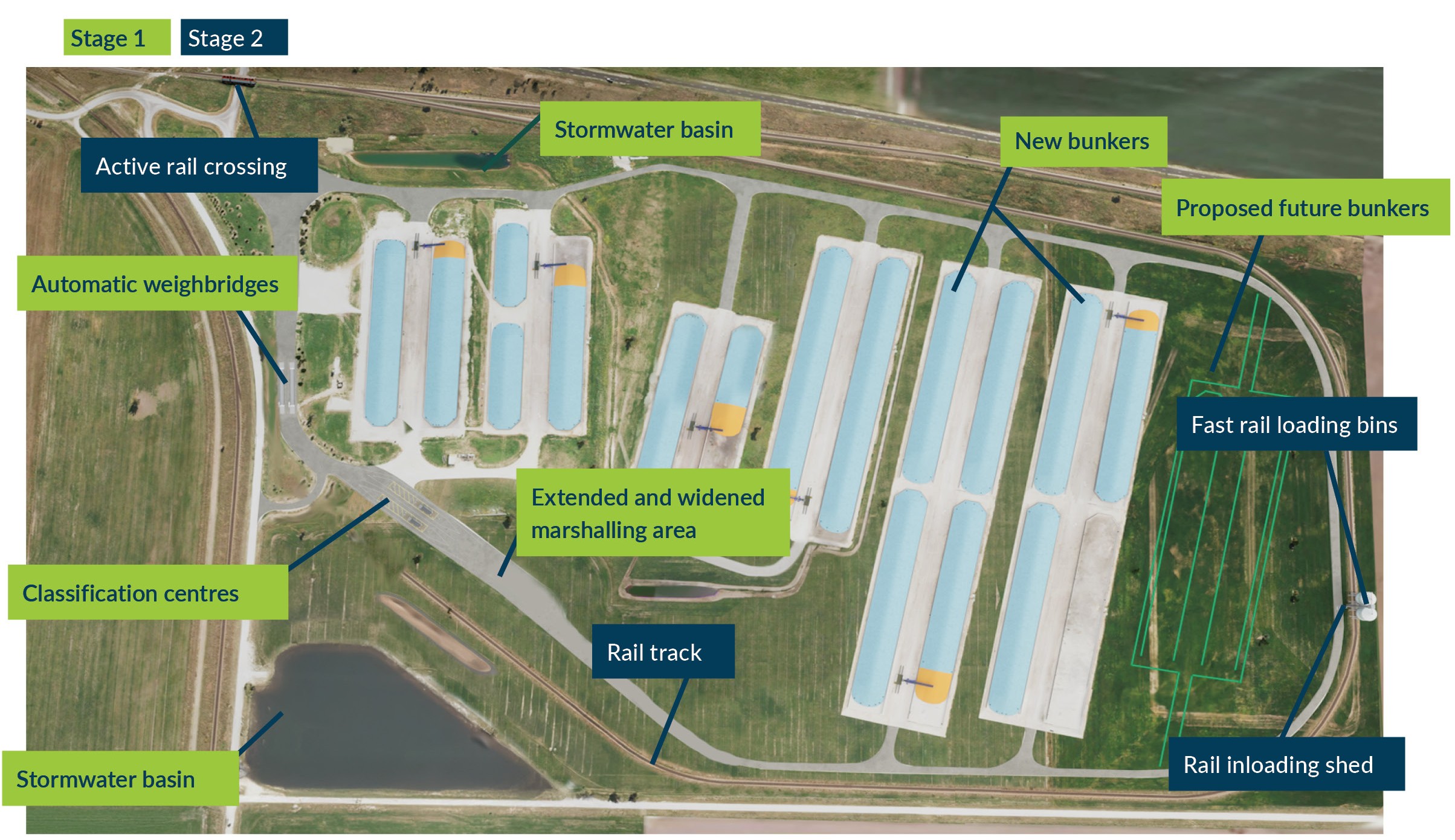
We are making a $50 million investment in our Wolseley site aimed at improving safety, expanding the site and creating efficiencies and value for our farmer and buyer customers and the local community.
This project is our single largest investment in our South Australian upcountry network and aims to meet the evolving needs of farmers now and into the future.
It will improve the farmer delivery experience with additional bunker storage, state of the art classification centres and new and extended weighbridges, marshalling areas and roadways.
It will also transition the site to fast rail loading which will provide reduced freight costs that we pass back to farmers and help move more tonnes to our Adelaide ports for export in the first half of the year, assisting farmers to achieve a premium for their grain. This part of the project is being delivered in conjunction with rail freight operator Aurizon.
Our Wolseley site is a key asset in the Bunge network. Being situated on the Melbourne to Adelaide freight rail line, it plays a significant role in supporting local grain farmers in the south east region of South Australia, and western Victoria, and connecting them with domestic and international consumers.
This investment is in addition to the $65 million we currently invest into our sites each year where it provides the greatest value to our customers through creating efficiencies, improving reliability and ensuring the long-term sustainability of our network.
Stage 1: improving the safety and efficiency of the delivery process for farmers and carriers
Stage 2: bringing fast rail loading to the site to be able to move more grain to port to meet demand
This project is an important step in our focus of making the South Australian supply chain more efficient to compete with interstate and international markets. It’s one of the many long-term investments we’re making aimed at strengthening our network to the benefit of farmers, buyers, the community and industry.
This timeline is subject to change based on approvals and contractor availability.
2024 (complete)
|
June - July (stage 1) |
September - November (stage 1) |
|
stakeholder engagement works contracts awarded submit development application |
weighbridges, road works complete bunker site, stormwater works start |
2025 (complete)
|
January (stage 1) |
February (stage 2) |
March (stage 2) |
July |
September (stage 1) |
|
classification area works begin |
stakeholder engagement |
submit development application |
classification area complete (stage 1) works contracts awarded (stage 2) |
bunker site, stormwater basins complete |
2026 (stage 2)
|
April |
October |
|
fast loading bins, inloading shed works begin |
fast loading bins, inloading shed works complete rail track works begin |
2027 and 2028 (stage 2)
|
April 2027 |
Q2 2027 |
April 2028 |
|
rail track with manual level crossing complete |
first train |
active level rail crossing complete |
We have engaged a stormwater specialist to assess the existing and potential project-related stormwater impacts.
Management of stormwater from the site catchment area will include an upgrade of the site stormwater detention basin system to prevent uncontrolled stormwater runoff from the site and incorporate a proposed controlled discharge to the town stormwater system through the summer months.
In addition to this, the collected stormwater will be used for dust control and other operational uses onsite. The catchment areas external of the Bunge bunker site as part of the rail track works is not expected to increase the volume of water, however additional drainage infrastructure will be installed to maintain proper flows through the town system utilising the existing local discharge points.
These upgrades are being developed in conjunction with the Tatiara District Council.
We will apply appropriate mitigation strategies to reduce potential noise generated by operational activities, vehicle and rail movements. We have engaged a noise specialist to assess the potential project related noise impacts.
We have put in place mitigation strategies to reduce potential dust generated by construction and project related vehicle movements.
The project will be assessed via a Development Application under the Planning, Development and Infrastructure Act 2016. The relevant consent authority will be the District Council of Tatiara.
Key steps and timeframes:
© 2026 Bunge.